Coffee Brewing 101
brewing like a Naysayer
Coffee Brewing 101
This beautiful amber liquid that we all love is the result of extracting sugars, acids and other compounds that are held within the plant matter of the coffee bean (which is really the seed of a fruit). By brewing our coffee intentionally, we can control how much or how little of these compounds are extracted into the cup. We’ve created some general guidelines for brewing some of your favorite methods.
Step #1 -Let it Rest:
When brewing our coffees for filter coffee, we find they express themselves best 8-14 days past the roast date. When a coffee is roasted CO2 is trapped inside, and giving the coffee time to rest allows the gas time to escape. This is important because the CO2 can create a barrier between the coffee and water while brewing, resulting in a poor extraction. When brewing for espresso, we recommend brewing 14-21 days off roast. We recommend storing your coffee in a consistently cool dry place (kitchen cabinets are great).
Step #2 - Pick Your Coffee: Water Ratio
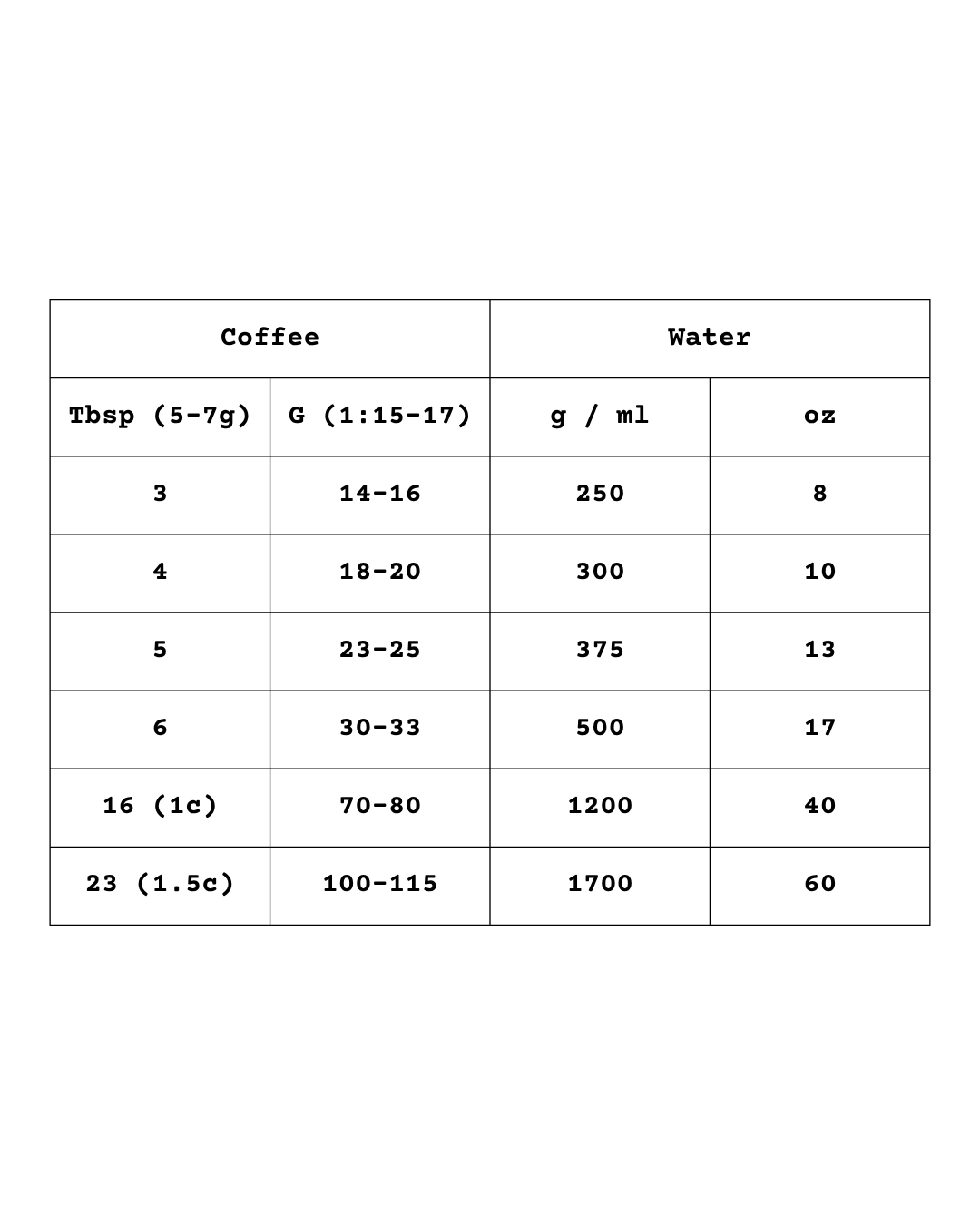
With our filter-brewed coffees, we like to start from a baseline Coffee : Water ratio of 1:15. This means that for each gram of coffee, you’ll need around 15 grams of water. This ratio can be varied to your preferences, but this is a good starting point. We’ve included a chart below for quick reference!
Step #3 - Select Your Water Temperature
We think that a solid baseline is 203F, but will vary our brew temp slightly depending on different variables of the coffee at hand.
The temperature at which we brew our coffee will greatly affect the flavor of the cup. If the water isn't hot enough, some of the coffee’s sugars won’t be broken down and your brew will result in an imbalanced cup (too light, thin, sour, tart). However, if your water is too hot, it could scorch and deteriorate some of the compounds in your coffee that are also essential to achieve a balanced cup (burnt, ashy, drying, bitter). The idea is to land somewhere in the middle so that you can extract all of the desirable acids and sugars into your cup without damaging any of them.
Step #4 - Select Your Brew Recipe
We’ve listed some of our recommended recipes below!
Step #5 - Brew and Enjoy :)
Your can also modulate the flavor of your coffee by limiting or extending the amount of time that the coffee is brewing. Different compounds within coffee require different amounts of contact time with hot water to be extracted. The acids within your coffee are among the first compounds to be extracted, the sugars that balance them out take a little bit longer to break down.
For tinkering purposes:
If your brew is too bright/acidic and the brew time seems too quick, aim to prolong the brew and this may help balance the sweetness of the cup (finer grind or more agitation). You might also try using a bit less coffee or more water in your brew recipe.
If your brew is lacking brightness acidity or is starting to become astringent/bitter, it may be over extracted and you could benefit from speeding up the brew a bit (courser grind or less agitation). You might also try using a bit more coffee or less water in your brew recipe.
V60 (Open-Bottom Dripper)
Preheat kettle to 202F & grind 25g coffee at a medium setting
Rinse V60 (filter inserted) and carafe with hot water
Empty rinse water
Dose coffee into pre-wet filter and tap to settle into a flat bed
@ 0:00 pour to 50g by 0:15
@ 0:45 pour to 200g by 1:15
@ 1:45 pour to 275g by 2:00
@ 2:15 pour to 325g by 2:30
@ 2:45 pour to 375 by 3:00
Brew should finish by 3:30-3:45
Kalita Wave (Flat-Bottom Dripper)
Preheat kettle to 202F
Grind 20g coffee at a medium setting
Rinse Kalita (filter inserted) and carafe with hot water
Empty rinse water
Dose coffee into pre-wet filter and tap to settle into a flat bed
@ 0:00 pour to 60g by 0:15
@ 0:45 pour to 120g by 1:00
@ 1:15 pour to 180g by 1:30
@ 1:45 pour to 240 by 2:00
@ 2:15 pour to 300 by 2:30
Brew should finish by 3:15
Drip/Filter 8-cup (5oz cups)
Fill coffee maker with 1200g/ml (40oz) of water
Place a paper filter in the basket and rinse with hot water
Grind 80g of coffee at a medium/course setting
Dose the coffee into your pre-wet filter
Begin the brewing process
Once all of the water has dripped through the filter, stir the coffee and enjoy!
Espresso
Grind 18g of coffee at a fine setting
Dose the coffee into your portafilter basket
Perform any WDT method if you so choose
Tamp the grounds evenly into the basket with 20-30 lbs of pressure
The top of the puck should now be a flat, even surface
Insert the portafilter into your espresso machine and commence shot-pulling
We aim to yield 30-35g of espresso within 25-30 seconds
Stir the shot or transfer into your drinking vessel and most importantly, enjoy
Coffee : Water Ratio Chart